

I’ve been thinking a lot recently about where all of this is headed…
The market, the product manager profession, and, of course, my beloved topic of “growth.”
I’ve felt for a while now that there’d be a seismic shift coming - and fast - but it wasn’t clear exactly what that shift would look like. So, I held back on some things like writing a PLG book or developing too deep of convictions about “AI” and it’s effect on the market.
That’s done now because I’m confident enough to make a bet on what’s coming.
Allow me to attempt to sell you the most valuable commodity in the world: some certainty in a world of uncertainty.
What we’ll cover
2024 vs 2025
“AI”
AI as an improvement to product value vs. capital invested
AI is a fundamental change in how GTM functions
Past, present and future
Organizations & and the Product Management profession
Product-led Growth 2.0
Product-led Sales?
Before you tune out:
I know that a lot of Product Managers often tune out when a topic includes words like “GTM”. But especially if you work on a product, I encourage you to trust me for a second; it’s very important that you stick with my train of thought to the end.
2024 vs 2025
Last year, I wrote an article called “The upcoming 2024 Bloodbath in SaaS,” in which I said that a new Age of Growth was upon us. Companies, I predicted, would pay the price for not understanding what “Growth” is or, specifically, Growth teams1.

In 2023, when AI started to get on the scene, I also predicted (on my other Substack) that the SEO game would fundamentally change because a lot of companies are losing access to real estate where they can advertise:

I still think both of these claims are fundamentally true (and not revolutionary in themselves), but I underestimated how fast and heavy these changes would come and what it would mean for the industry, the profession, the organizations we work in and mostly, product-led growth.
“AI”
One thing that particularly annoys me about the AI discourse is all the rage baity one-liners:
“AI kills SEO!”
“AI replaces Sales!”
“AI kills the PM role!”
Let’s act like grown ups, please.
I think there are two distinct drivers we’re all talking about when we bring up AI:
AI as an improvement to product value vs. capital invested
AI as a shift in how GTM works
We’ll dive into both below. Then, I’ll share my specific predictions on how this all shakes out:
AI as an improvement to product value vs. capital invested
In 2023, my team at Jua was building an AI end-to-end foundation model the size of ChatGPT 3.5. Here was our oversimplified pitch:
“We can predict the weather on planet Earth to a degree that has not been possible to date with the current technology.”
What looked at first glance like an overhyped marketing statement started to feel very real with a speed that was simply overwhelming.
Not only did AI (specifically deep learning) at that point become amazingly fast with transformer models, but the models themselves kept improving.
Almost every week, there was a new breakthrough, which allowed for new breakthroughs.
That left us trying to build something meant to last in the market for years while the underlying state-of-the-art technology improved so fast we’d need to reiterate constantly before ever finishing.
Add to that the complexity of physics and non-linear systems like the weather, and you have, in weather terms, a perfect shitstorm of everyone feeling equal parts overwhelmed and overexcited.
And that was all in 2023.
Things have improved even more since then, and we have reached the point where anything you’re building now has the serious potential to disrupt existing solutions that were built in pre-AI markets for pre-AI organizations.
For example: CRMs
A good example to illustrate this is CRMs.
The way they have been built in the past was all around workflows to make the entry of data and customers easy for sales, but the underlying assumption was that a person over an interface did the majority of this process.
The winners in this category (mainly Hubspot in my book) were differentiating themselves by having a more simple-to-understand, quicker-to-value product than their competitors (think Salesforce).
There are obvious signs now in the market that the future for CRMs through AI will go much further than this (or at least fragment it), reducing the need for “babysitting” your contacts and leads less and less.
The question of when AI-led products grab more of this market share is much more “when” than “if.”
Whether you believe the overhyped claims that AI is replacing engineers forever, at the very least, we can probably agree that “building” software is getting easier and easier with the help of AI tooling. (Especially for ‘simpler’ solutions)
Let’s just agree that AI allows us to do things that were not possible before but also, allows us to build existing products with a comparable quality to solve existing problems for less money.
Whether that’s the automation gains in engineering, product, etc., doesn’t matter. It requires less and less capital to ship something (good), particularly in SaaS.
AI is a fundamental shift in how GTM works
I cannot tell you what the future exactly looks like in how we generate demand through products, but I can tell you how it’s not going to look and what’s going to stop working.
The vast majority of successful companies I looked into over the last three years had an overreliance on one specific channel to drive their demand.
Whether that’s specific Social media channels, offline or SEO, there was is always this one channel that the company could not afford to lose because it drove 80% of their revenue.
It was no different for us at Smallpdf. Without our dominance in SEO, we would not have ramped up volume so quickly.
This clump risk is nothing new, and yet I don’t know a single CEO who has successfully reduced it. So, we have kind of just accepted that to be a reality of company building.
In the case of SEO, it’s not “really” dying, but it has seen its peak. It will remain important, of course, but if you’re betting on your long-term future, relying on SEO is no longer a foregone conclusion. Soon, I predict, reliance on SEO will become industry and situation-dependent rather than generally just a good idea to do without question.
Why? People have alternatives to search engines that are starting to be more relevant. Whether it’s more human recommendations or LLMs like Claude and ChatGPT, the importance of a search engine is declining:
The hard thing is not to find “any” solution for your problem nowadays, but “the good one”.
Also, because customers get “burned” so often, trusting what a company says becomes harder and harder to trust.
This effect will increase more and more with time.
The industries reaction: Influencers
Now, we are not idiots in this industry. We’re trying to react to this trend by seeking new ways to sell to customers.
And we had a brilliant idea: B2B Influencers. They have all the advantages of salespeople without being salespeople.
People trust them. People buy from them, they would not advocate for something that’s not in our best interest. It’s great! Or is it?
In the last years, we saw in B2B a heavy drive towards influencer-driven demand generation because customers' expectations to evaluate solutions have shifted. Reviews from anonymous people could be easily manipulated and felt fake as companies promised things they ultimately couldn’t deliver.
(My business is a good example, I’m investing almost nothing in SEO and drive everything with my personal brand. It’s less about what I talk about but whether people believe my topical authority of what I claim)
So this is a funny one. I don’t think it’s gonna work anymore either.
This entire B2B influencer game, while being very young, is also gonna have its reckoning and will contract quite heavily unless I’m missing something here:
I wrote about this recently on LinkedIn, if you don’t want to read it, the Tl,dr is:
The capability of AI to fake content is sabotaging the ability for influencers/brands to generate genuine trust in the channels they function. (Let’s ignore that the amount of money they receive to peddle bs is also a problem)
The ability of people like me to generate leads with our access to the market will diminish:The influencer reach will be worth less, making it less valuable to do this in the first place.
Including CEO’s that decide to play the brand game. You have to push through the 100’000 of other automated CEO’s that will sound just as good as you.
Good luck with that.
And then, we have the problem that recommendations that are driven by monetization are kinda problematic, and people get burned by the channels they used to trust.
It’s like that aunt Linda that sells you her MLM scheme every time you talk to her. At some point, you tune out.
I advise you to rethink whether you want to become a Linda in B2B:

I have conversations like this one quite often (Daniel is the CEO of Truora has a sizeable 100,000 followers reach on LinkedIn built for his business)
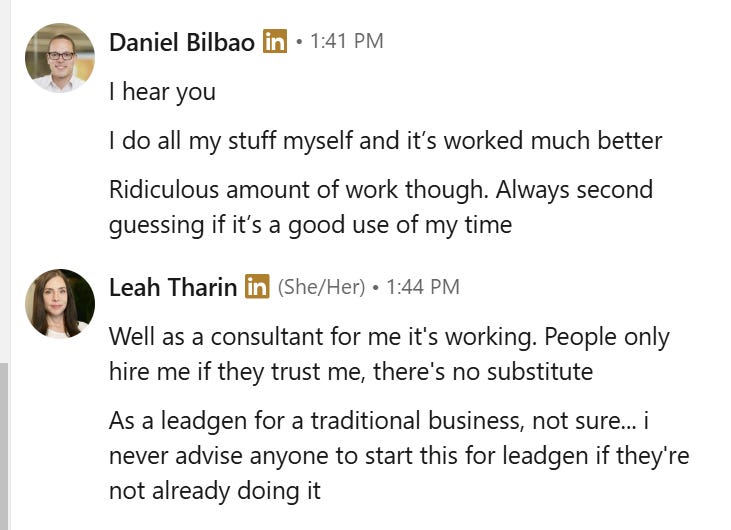
This entire move to influencers (and personal brand) was already a reaction to the more difficult access to markets by our current marketing teams and is, in some cases, even the dominant acquisition channel for a handful of businesses I’m working with.
At the very least, we can agree that marketing is getting more expensive and more complicated for the same reach as before because of AI and the influx of influencer money, which creates a conflict of interest.
Yes, marketing workflows will also get easier because of AI (the creation of messaging, content visuals, etc.), but while this makes it “cheaper” to do marketing, the overall net effect is a massive cost increase to do lead generation.
We’ll see massively increased competition while the size of the overall market is not increasing as quickly.
(And so many scams.)
The kicker is this: Let’s say what I’m claiming here is happening. SEO reach will be redistributed, and influencer reach will be redistributed among other channels over time…
…but where does it go?
That’s the million-dollar question when it comes to GTM:
I don’t know. And neither do you. But you could.
Past, Present, and Future
I encourage you to zoom out when you think about any of this from a first principles perspective. This is less about 2025, this is about the past and the future beyond and how we can bet on it.
If I’m trying to be as reductionist as possible, I would summarize it like this:
The past was about on-premise software until 2000, developing some product for a big problem at any cost
The present is/was about the SaaS revolution until… now?, developing the right products faster and simpler to be self-served
The future is all about the GTM heavy Product-led Sales revolution, finding and retaining customers through value and integration
Of course, all three of these needs are still present, but my prediction specifically concerns how every dollar spent in an organization will be divided to achieve the overall goal of creating a business that is making money instead of losing it.
Overly simplified, it might look like this:
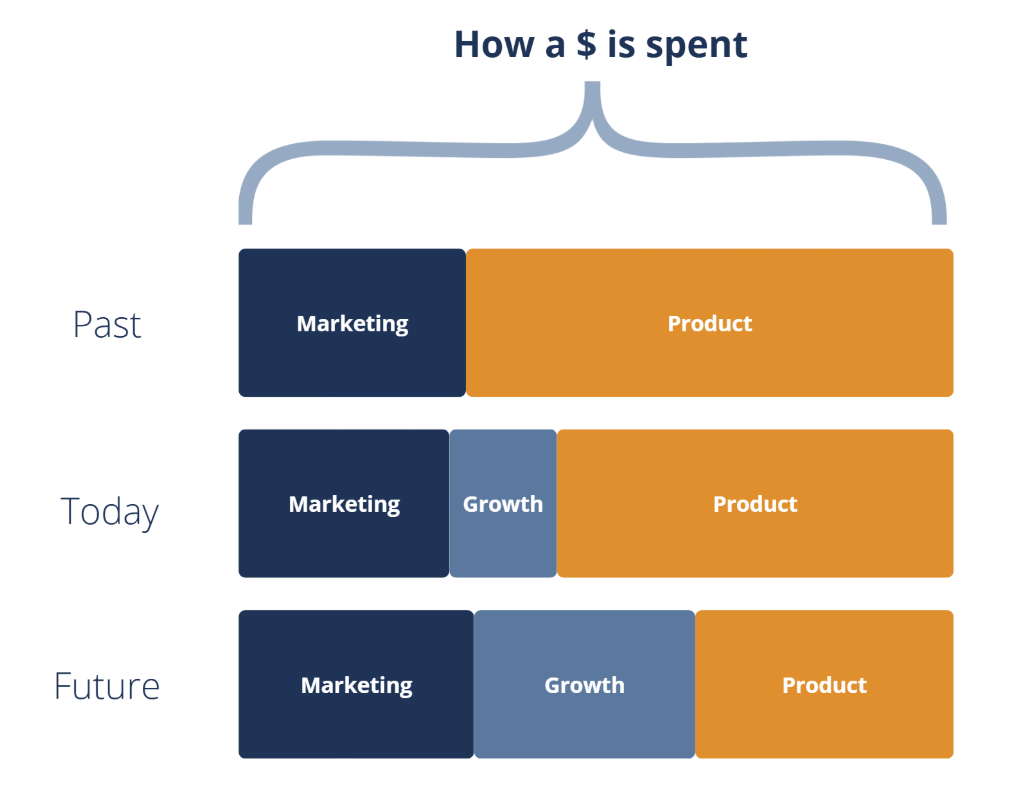
This looks like specialization to me. And it hits the PMs the hardest.
What happens to the PM profession??
Here are a few of my predictions:
The classical product team will shrink in size even further but the times of having teams where one PM is directing about ten people are definitely over. Brian Halligan’s prediction in one of his books years ago to have optimal team sizes of five is, in hindsight, almost prophetic.
I see it myself; I used to have an internal limit of eight and now write in my operating models for my clients, “Aim for five, accept six, but split the teams at seven.”
Large (anything above eight people in software) product teams to achieve an operational effect in any way are, to this day, a clear indicator of a dysfunctional organization. Aligning a group of people seems to increase in difficulty almost exponentially with size.
AI improvements allow us to do more with fewer people. While these improvements are already powerful, they also allow us to manage fewer people for the same gain. I don’t think people will appreciate enough looking back at how big of an effect this has on productivity.
Fewer people managers will be needed, specifically, product leaders who have no operational duties, like Product Directors. Between them and Group Product Managers (who traditionally are the direct reports of directors in larger companies), the director positions will be hit hardest.
The days of the generalist PM will become less important outside of seed companies that are trying to find product-market fit.
A couple specializations will gain further traction immediately in my mind:
Growth PMs: Quantitative optimization of onboarding, self-serving value, and monetization to connect product, sales, and marketing, strong quantitative analysis skills, and A/B experimentation knowledge.
AI TPMs: Technical AI knowledge in how to lead, structure, and evaluate an AI-driven team that utilizes or builds an AI model or integrates adjacent technology like wrappers, APIs, etc.
Product Marketing Managers: This job title already exists, but I’m talking specifically here about a job that is attached to a product, which serves as a further bridge toward marketing. (More on that in the next section)
Integration Product Managers: (I have no idea what to call this job.) They do a weird mix of what Growth PMs do and what the typical core product managers should have done in the first place: integrate existing products better into their customers' workflows without necessarily delivering new features.
The markets will, therefore, also be split between smaller, more specialized companies. (More revenue per employee, higher R&D, and tech cost)
For Product Managers, all of that means both good and bad news:
Bad news: Less PMs overall are needed than now in absolute numbers to serve the market.
Good news: The salary for PMs will increase due to the increased need to specialize in GTM, Growth, and AI.
Don’t believe me on my last point due to all the layoffs? I cannot remember a time when we had this much of an overabundance of candidates for generic PM jobs and such an underserving for specialists.
Most of my clients cannot choose from many candidates; they struggle to find one great one among 1000 (!!!) applicants.
Cross-functional teams 2.0
I don’t know how this one exactly shakes out, but cross-functional teams were the answer for product and engineering not talking to each other: we couldn’t figure out how to ship anything in time.
We’re good at this now in the industry. But now, we don’t know how to ship the right stuff because Sales, Marketing, Customer Success and Support are usually not present in these cross-functional teams.
Is the solution to throw everyone into one team? Probably not, but because companies have become smaller, these issues are now more solvable:
Maybe we have to say goodbye to the classical product team structure where you put a PM, a designer, and a couple of engineers in and rather focus on being more flexible.
Maybe the ideal team for a very specific problem you solve requires a sales guy in the team 24/7. Or someone from Customer success instead of a designer. The problem should dictate the team structure, not the other way around.
I’ve gotten much more confident to challenge these traditional structures, and I hope, no, I think more leaders will.
Marketing
Let’s discuss marketing very briefly. Today, good marketing is often associated with creating inbound traffic or a mix thereof through free content or value.
I’m thinking of this as a shift further out into the market and away from the marketing activities of the past, which were often centered around website landing pages and how to attract the most people to them.
Marketing is much more than that today, and we can see that in marketers' jobs that are entirely outside of classical company property lines (like the website), so to speak, with influencer marketing and channel farming.
The gap between future marketers and the product is, therefore, widening, and there’s an increase in opportunities to optimize the gap in between, which is now occupied by growth teams even more.
A great product marketing manager in my book lives under product, has engineers and knows how to run experiments that go deeper than landing pages.
Product-led Growth 2.0
The seismic shift I predicted is happening faster and more dramatically than even I anticipated in B2B SaaS.
We're moving from an era where product development consumed the majority of capital to one where marketing and growth take center stage. This isn't just another buzzword - it's a fundamental restructuring of how successful companies will operate.
Let me be crystal clear about what this means for you:
If you're a PM today, you need to pick a lane. The generalist PM role is dying outside of early-stage startups. Your options are becoming a Growth PM with strong quantitative skills, an AI TPM who can actually lead technical AI initiatives, or a Product Marketing Manager who can bridge the widening gap between product and market.
The good news? These specialized roles will command higher salaries. The bad news? There will be fewer PM positions overall.
For companies, this means rethinking your entire organizational structure. The days of massive product teams are over. If you have more than 6-7 people on a product team, you're probably doing it wrong. The future belongs to smaller, more specialized teams that can move quickly and adapt to rapidly changing market conditions.
And for those still betting their entire GTM strategy on SEO or influencer marketing - wake up. The landscape is shifting beneath our feet. AI is simultaneously making marketing cheaper to execute but more expensive to succeed at. The real winners will be those who can navigate this paradox and find new ways to reach customers through genuine value delivery.
The Product-led Growth we've known is evolving into something new - something that demands a deeper understanding of both market dynamics and technical capabilities. It's no longer enough to just build a great product and hope people will find it. The future belongs to those who can seamlessly integrate product, growth, and marketing into a coherent strategy that delivers real value to customers.
We will see the ratio between Growth teams to classical Product teams shrink with time and this is reflected in the roadmap of what you build.
Less general hit and miss features, more complex integrations into your ICP’s life.
The choice is yours: adapt to this new reality or get left behind. Trust me - I've seen enough market shifts to know this one is real, and it's happening now.
How you do that?
Oh, you are going to hate this overly simplistic answer:
Talk to your best customers, find what makes them churn, and then learn about their specialties. You might find that boring integration and flow optimizations for your ICP retain better than more shitty features that no one adopts.
That’s growth in product management in 2025 and beyond.
Product-led Sales
How is this reflected in what I (Hi, my name is Leah) do? I’ve started to rewrite some of my product-led growth material to lean heavier into the growth aspect of it all which informs my course on Maven.
Namely, we need more optionality when we talk about product-led growth besides just thinking about freemiums and trials. The more upmarket your company is serving something, the more likely it is that you need a specialized solution that might not be “just do a freemium” but thinks more in the lanes of:
“What is the most cost-efficient way to find and generate real trust with the best customers that stay with us for years to come?”
Sometimes, it’s product-led growth. Sometimes, it’s sales-led growth.
But most likely, it will be about Product-led Sales a tailored mix between both.
Strap in Gary from Sales, this is going to be wild.
And because it’s on brand, let me pitch-slap you before it becomes ineffective:
My Product-led Growth in B2B course on Maven is running two new cohorts this year:
March 18th - Apr 3, 2025
May 19th - June 5, 2025
Psst: Because you read all the way to the end, here’s 20% off ;)
(Growth teams have the main job of optimizing the paths into the product from whatever traffic is coming from your marketing efforts. They are a “relatively” young, new concept)
I love this take on the whole, Leah. I’d be interested to hear your take on how this plays out by customer tranche (B2SMB, B2MidMarket, B2Enterprise) or by pricepoint (3-4 figure ARR vs 5+ figure entry points).
Also, could you provide a practical example for what an IPM would do to “integrate existing products better into their customers' workflows without necessarily delivering new features”?