


You shipped a conversion lift last quarter. Maybe 4 to 7 percent. The metric moved. You wrote it up for your performance review, the conversation went well, the next round of OKRs has you doing more of the same.
A version of that loop has powered most PM careers for the last decade. Find the step in the funnel that’s underperforming, optimize it, ship the win, get recognized, repeat.
I should know, it worked for me. But it doesn’t anymore.
The PMs I see getting passed over right now aren’t the ones who can’t ship. They’re the ones whose entire track record is shipping. Each win was real. Each promotion was earned. And the skill stack underneath it is exactly what AI commodified first.
Content
The trap. Why optimizing steps stops working when the Metric itself is moving.
What earned the old promotions. The PM skills that are now baseline.
What compounds now. The four skills that separate PMs in 2026.
What the market is selecting for. The dual-capacity bar good leaders hire against.
What to practice. Six deliberate practices to build the new skills.
Adjusting your CV. How to rewrite bullets for the new bar.
Approaching the interview. How to position yourself live in the room.
1. The trap
Take an onboarding flow built around a specific AHA moment for a product around Email management like we have at Fyxer.
The product wants the user to feel one thing in their first session: this AI actually understood my inbox. Every step is engineered to deliver them to that moment.
→ Sign up. → Connect Gmail. → Grant the permission scopes. → Pick a few categorization preferences. → Wait while the model processes the last six months of mail. → See the categorized inbox view. → Read the first AI-generated summary of an unread thread.
Each one of these steps can be optimized. Each one moves a metric the team can point to in a review.
What the roadmap cannot ask though is whether the AHA is still the right AHA moment. Whether the overall process is still the correct one.
Not long ago, “AI categorized my inbox” felt like magic. Today every tool does it. The user is no longer surprised at the categorization. They’re surprised when the auto-drafted reply sounds exactly like them. The journey was built for an AHA that already commodified, and no amount of optimizing the wait state recovers that.
And this is extremely common for a lot of products that PM’s manage today:
Product-market fit moves faster than it used to. Every AI cycle compresses how long a given AHA stays magical. Teams ship faster, which means they focus on what they can ship more, which means the journey they’re optimizing toward is more likely to already be the wrong one.
The instinct is to grip what’s easy to change.
The question that actually matters is the one that’s harder to change: is the AHA-Moment or Metric I’m responsible for still the right one?
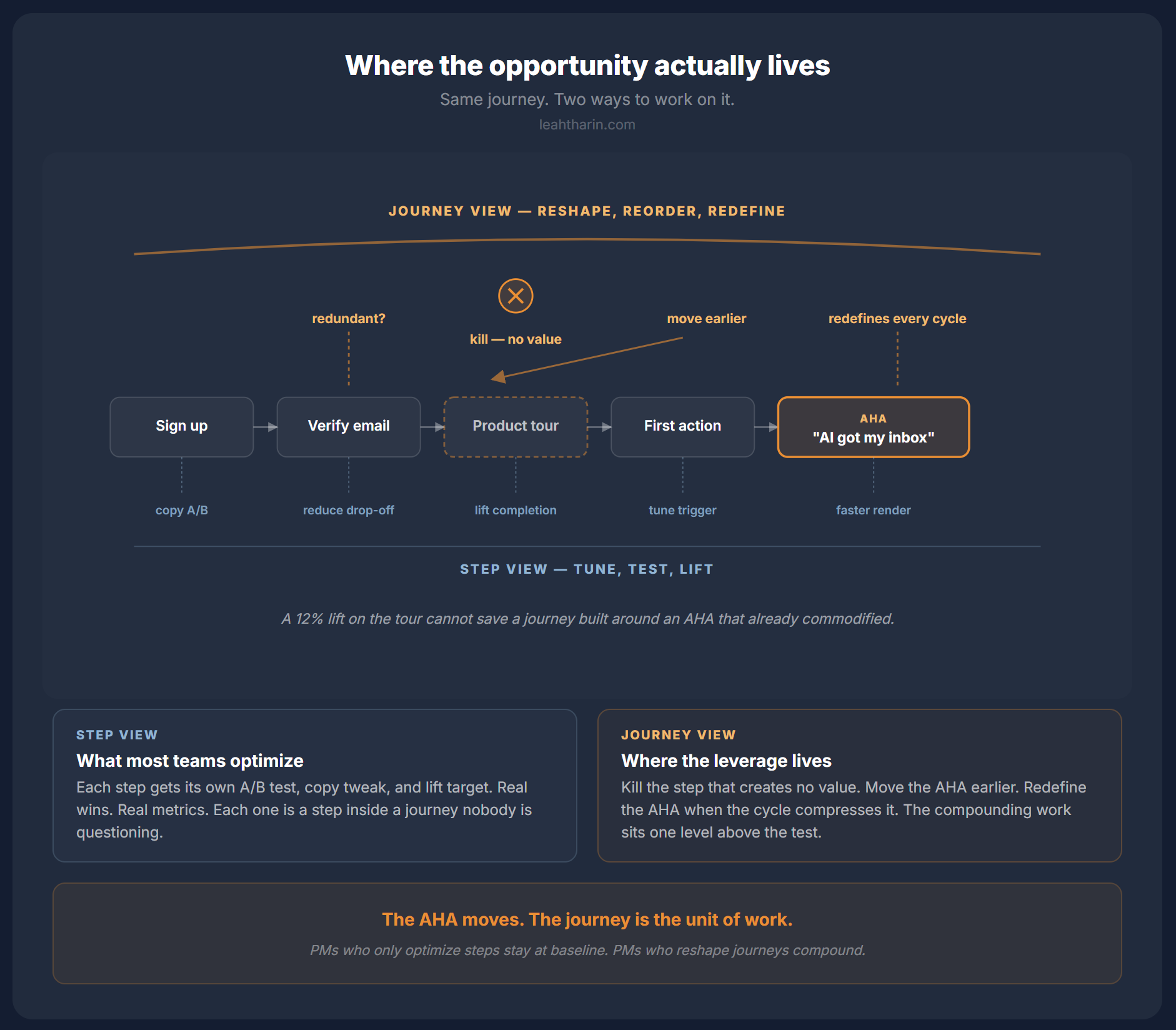
Especially in Growth, the construction of the first moment and onboarding has become an inseparable part of the product as the surface (where people consume the product) is shifting constantly (Desktop, Mobile, APIs, MCPs, Voice, LLMs, Integrations…)
That’s not a side note anymore of what it means to be a good product manager. Building the product and shipping it is not hard, distributing it is.
Whether you’re doing this as a growth PM in an onboarding funnel at the beginning or inside of a complex flow distributing it flawless in the core product.
2. What earned the old promotions
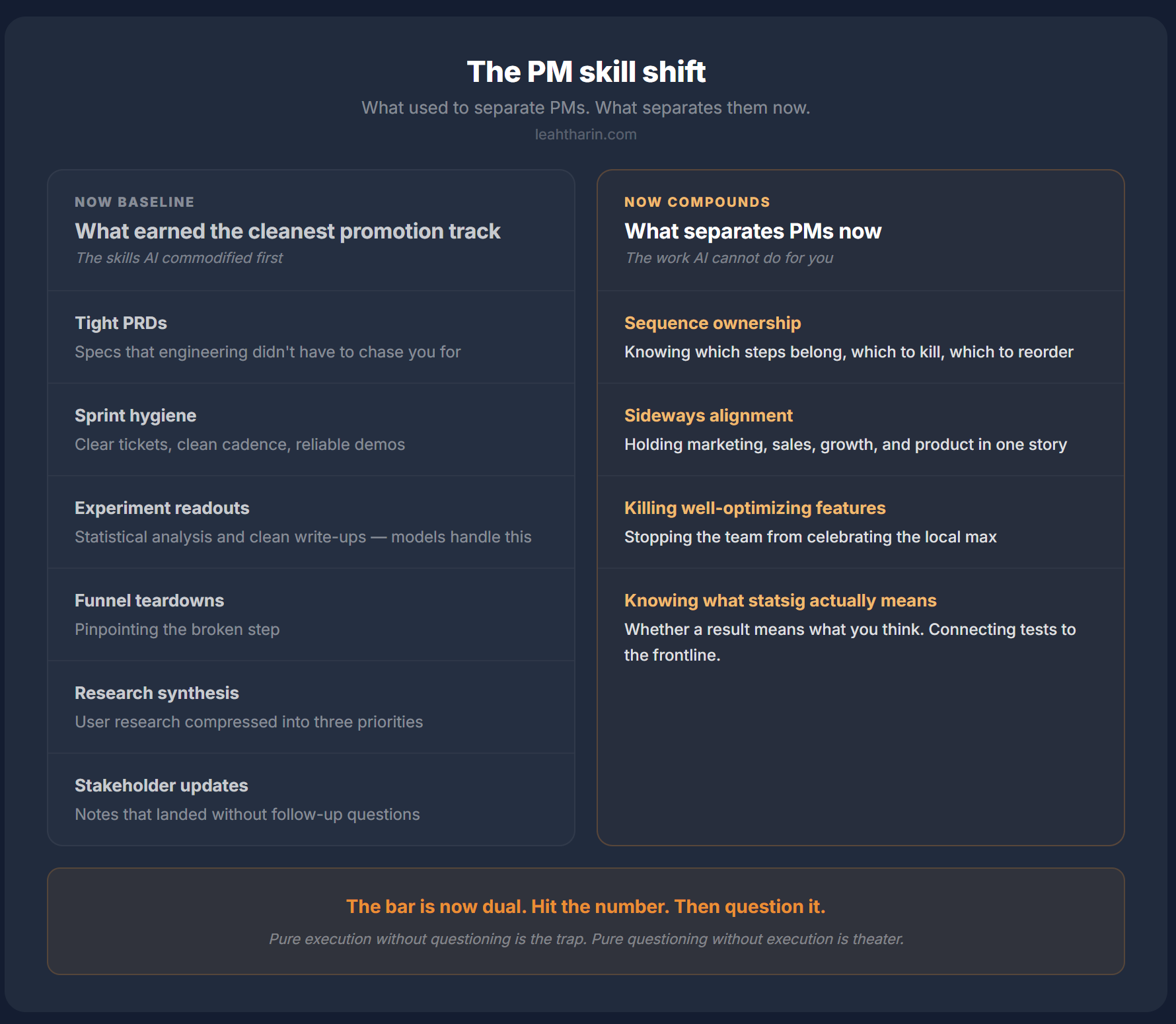
Look at the skills that earned the cleanest promotion track in product over the last decade:
Tight PRDs that engineering didn’t have to chase you for.
Sprint hygiene: clear tickets, clean cadence, reliable demos.
Crisp experiment readouts.
Funnel teardowns that pinpointed the broken step.
User research synthesized into three priorities and a roadmap.
Stakeholder updates that landed without follow-up questions.
Each one is a real skill. Each one took years to develop. Each one was the visible signal in performance reviews that you were “execution-strong” and ready for the next level.
Each one is now baseline.
That doesn’t mean these skills stopped mattering. They still ship the work. But they stopped separating one PM from another. The bar moved up.
What used to mark you as a strong PM now marks you as a competent one. The PMs who built their identity on these skills are arriving at a destination that’s been quietly redrawn while they were getting better at hitting the old one.
3. What compounds now
The skills that compound now sit one level above the steps. They aren’t faster versions of the old skills. They’re a different shape.
Sequence ownership. Knowing which steps belong in the journey at all, which ones to kill, which ones to reorder. Asking “is this the right customer success metric?” before the team starts asking “what can we do to add value?”
Sideways alignment. The work of holding marketing, sales, growth, and product in one story. AI cannot do this, because alignment is about reconciling competing humans, and AI doesn’t have skin in the game. The PM who walks the org sideways before the org realizes it needs to is the PM who becomes hard to replace.
The judgment to kill features that are optimizing well. When the metric is going up and you can feel that the destination has moved, the move is to stop the team from celebrating. That call is unpopular and load-bearing. Most PMs do not make it.
Pattern recognition when metrics lie. Not data analysis. That part is increasingly automated.
The reverse: noticing when everything looks good and the picture is still wrong. That instinct compounds because it is genuinely hard to teach. The longer you use a metric the more likely a company finds a way to abuse it, I see this in almost every gig I’m looking into, for instance:
It starts with a well intended: “Hey, let’s improve the number of trials we have” and ends in a complete shitshow 2 years later because marketing figured out how to boost the numbers with completely useless traffic.
None of these skills are faster execution. They’re the work that decides whether the execution was worth doing.
4. What the market is selecting for
This isn’t a quirk of how I hire. It’s what the market is selecting for now.
Good growth and product leaders are no longer asking, “can this person execute against a metric?” That part is assumed. They’re asking, “can this person execute against a metric and question it?”
The new bar is dual. Hit the number. Then notice when the number is wrong, and reframe what you’re executing toward. The PMs who do both compound. The PMs who can only do the first half are running in place inside an environment where the destination keeps moving.
At Fyxer I look for the same thing the rest of the market is moving toward. Candidates who describe their last role purely in terms of metrics shipped have a hard time with me. Candidates who describe what their work meant across the company, who naturally talk about how they questioned the metric they were given, have an easier conversation.
“Do they intimately understand the system they were in?”
Many of the PMs I would have hired three years ago wouldn’t make it past this conversation now. Their answers were good for the old definition. They are not good for what the role is becoming.
If your last three wins were optimizations against a metric someone else defined, that’s the signal.
The fix is not to ship harder. The fix is to step one level above the metric. To start asking what journey it lives inside, what AHA it leads to, whether either of those still holds.
To execute and to interrogate, in the same job.
5. What to practice
Knowing what compounds is different from being able to do it. The four skills above sit one level above the work most PMs were trained on. They have to be developed deliberately.
What you should do if you’re still stuck in the classic PM mindset:
Sit in functions that aren’t yours. Not “be aware of sales.” Actually sit in sales calls. Attend marketing planning. Watch a customer success QBR. Sideways alignment comes from texture you cannot get from product meetings, and the texture is what makes you naturally see your work in the system.
Yes, you might not be able to change inefficient meetings from other silos but at least you understand the constraints better you’re working in.
Expose yourself to customers regularly, and don’t script the conversations. Support tickets, sales call shadowing, unscripted user calls. Yes, it’s boring. It’s also non-negotiable. PMs who say “I don’t have time for that” have the time. They’re choosing not to make it. Sequence-questioning instinct comes from the moments customers surprise you, not the ones where they confirm your hypothesis.
Kill at least one thing per quarter. Pick something mid-execution that is optimizing well but you sense is the wrong destination. Stop it. Document why you stopped and what you replaced it with. The kill muscle atrophies if you only ship, and the people deciding who to promote are watching for evidence you have it.
Estimate the commercial impact of every decision before you ship. Check after. Most PMs never estimate. They ship, look at the metric, and post-rationalize. Calibration is the only way to develop commercial intuition, and commercial intuition is what tells you when a metric is going up for the wrong reason.
The mindset of “let’s just experiment and see what we learn” to me is the number one red flag for any PM that doesn’t think before they ship.
Set a kill criterion before each project. Write down what would make you stop, before you start. Most PMs never do this. The act of writing it forces journey-thinking instead of step-thinking, and the document itself becomes the artifact you point to when you have to make the kill call later.
Become AI-native, but in the right way. Using AI tools is now table stakes. The compounding skill is managing team context: the body of knowledge your team and its AI tools work with. Knowing what belongs, keeping it current, filtering the garbage out. PMs who treat AI as a faster way to ship execution work stay at baseline. PMs who treat it as the substrate their team thinks in develop a different kind of leverage. I’ve written more about this elsewhere.
A good way to think about this is not the amount of documents that you write for the team but how many of them you maintain. Keep few documents, 1 current plan, 1 strategy, 1 sheet of assumptions but always up to date.
6. Adjusting your CV
The same trap shows up in how PMs write their CVs. Most CVs read like a step-optimization log: features shipped, lifts achieved, sprints run, teams led. Every bullet is a local metric inside the writer’s team boundary.
A few practical changes pull a CV up to the new bar.
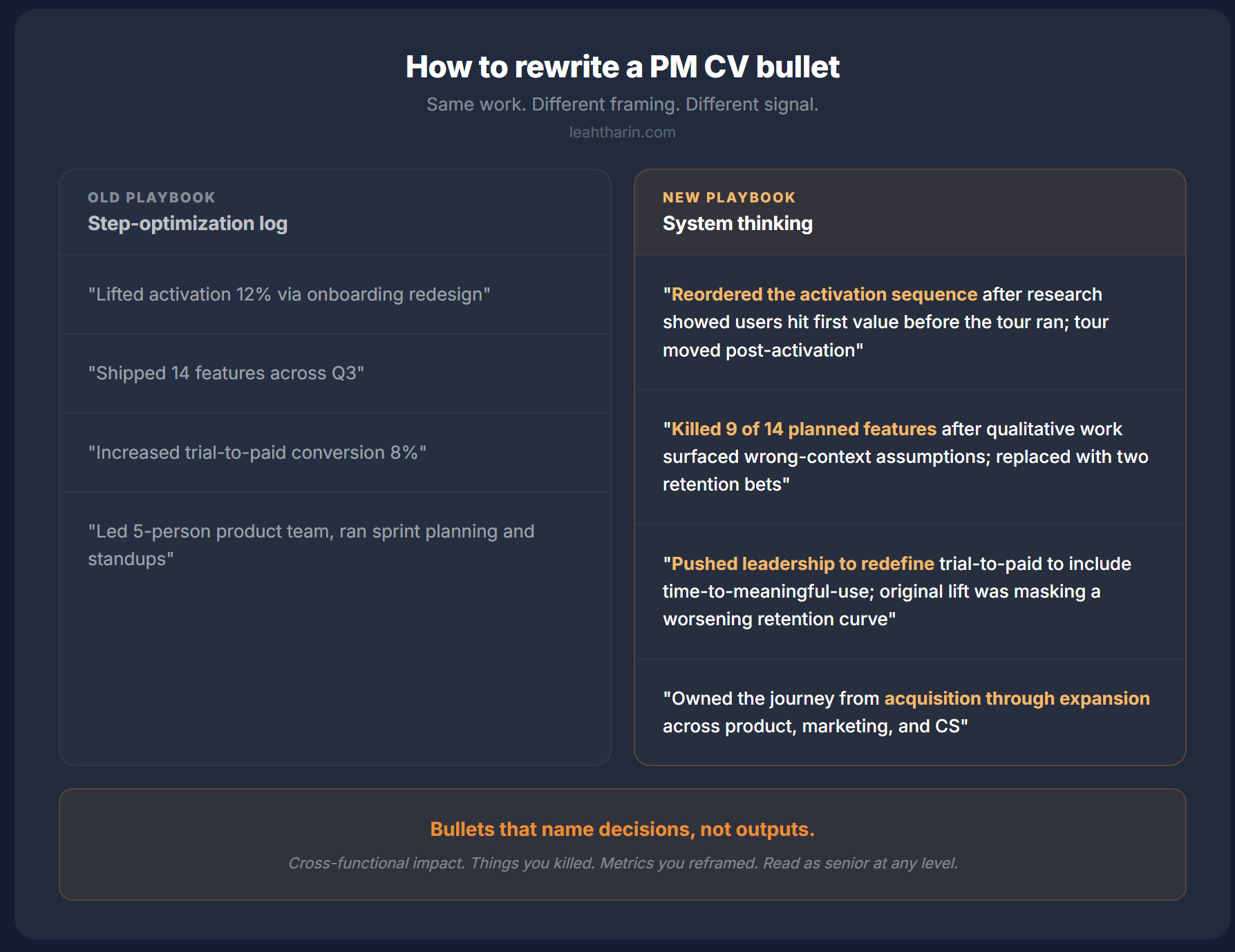
Replace metric-only bullets with decision bullets. “Lifted activation 12%” tells me you executed. “Reordered the activation sequence after qualitative research showed users were hitting first-value before the product tour ran” tells me you executed and questioned. The first is replaceable. The second is rare.
Name the cross-functional impact. For each major project, what did your work mean for sales, marketing, CS, support? If the answer is “nothing measurable,” the project was probably small. Bullets that connect product work to revenue, retention, or load on other functions read as senior. Bullets that only name product metrics read as junior, regardless of seniority.
Include at least one thing you killed. A CV that’s only shipped-things is a CV from the old playbook. One bullet that names what you stopped working on, why, and what you replaced it with signals the judgment that compounds.
Cut the ceremony language. “Led standups,” “ran sprint planning,” “managed Jira.” None of this differentiates anymore. The work still has to happen. It just no longer makes the shortlist.
7. Approaching the interview
Interviewing for a role at a company that’s hiring against the new bar is different from the old format. You’re not being measured on whether you can describe what you shipped. You’re being measured on whether you naturally describe the system around it.
Lead with cross-functional impact, not team output. When asked to describe your last role or project, do not start with “we shipped X.” Start with what the work meant for the business: how it changed sales conversations, how marketing positioned the launch, what it freed up or cost in support. The features come second. The interviewer is listening for whether you naturally see your work in the system.
Have a “what I killed” story ready. One concrete project you stopped working on, why, and what replaced it. If you cannot answer this, the interviewer learns that you only know how to add. Adding is no longer the differentiator.
Distinguish “we hit the metric” from “I changed what we were executing toward.” The PMs who get the offers describe at least one moment of reframing. A metric they pushed leadership to redefine. An experiment they killed because it was optimizing the wrong thing. A roadmap item they replaced because the journey shifted underneath it. These stories read as senior at any level.
Question the metrics the company presents to you. When the interviewer describes their North Star, their activation rate, their growth bet, do not just nod. Ask why that metric and not another. Ask what it captures and what it misses. Ask what would have to be true for it to stop being the right metric. The same skill you’re being screened for is the one you can demonstrate live, in the room, on the company’s own framing.
Be honest about what you don’t know. Hedging in an interview to look broadly capable is a tell. Saying “I haven’t done X but here’s how I’d think about it” reads as confident. Pretending you’ve done X reads as fragile.
The trap is invisible from inside it. The metrics still go up. The promotions still come. The skill stack you built still ships the work. Then the cycle compresses, and the people one rung above you are doing what AI cannot do, while you are doing what AI just did.
The CV and the interview are where you change that, before the cycle does it for you.
Feedback
What’s still missing in my guide? Let me know where you feel like it has gaps and I’ll add it in subsequent versions.
Thank you Leah for writing these thoughtful and insightful articles. New fan.
I think one thing that remains a constant is the focus on outcomes. In a resume, on a roadmap, during planning. Everywhere.