

Sponsored by: Churnkey drastically reduces voluntary & involuntary churn for SaaS companies like Jasper, Veed.io, Copy.ai. It helps companies save 20%-40% of revenue that would otherwise be lost to churn.

I slacked off.
A couple of months ago, I posted less on Substack and LinkedIn. It was a very stressful time at my interim gig at GotPhoto, moving houses and catching the norovirus.
Above not being motivated to play the LinkedIn game (and becoming a bad one liner machine), I’m careful about where my priorities lie. The clients always come first, and my personal demand generation channels come after that. And thus I posted less on them, first gradually then some weeks not at all.
Every time I go now into my Substack dashboard, I dread the number I see, and it’s a source of anxiety.
Here’s the price I paid for it with my paid subscribers on Substack:
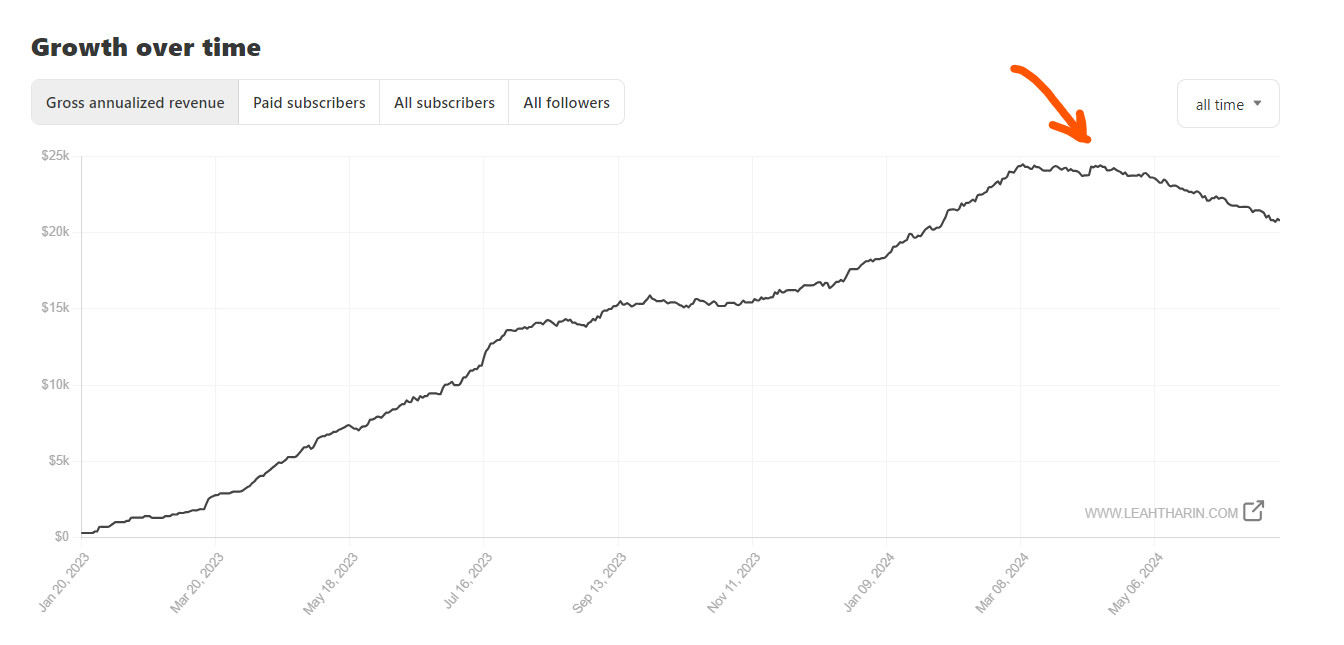
I can measure on Substack specifically through paid subscriptions, which I think are a great indicator of high intent value from people who follow me around.
The Red Arrow is where it started to get intense in my interim role, pivoting a product to be product-led at scale (rather than reactive over-engineering and sales), which required a lot of 1on1 time with all my teams.
The declining curve almost matches my release schedule for good content. My open rates for content when I do send something are stable, and I’m even gaining free subscribers, so it’s not a big problem per se.
But I’m far behind my target on what I wanted to achieve this year on these platforms.
There’s something to learn here about demand generation in general and how the field is getting more crowded with things that are obvious.
Things that worked become harder
“Build your brand on LinkedIn!”
“Start a Substack!”
“Do a Podcast bro!”
Everyone talks about it; everyone tells you how awesome it is once it works, and… it is. I feel in many aspects, I was just in time to get them started 2 years ago, but the space is getting extremely crowded.
That means for businesses and solopreneurs like me, the amount of money or time spent is rising dramatically to achieve the same as before.
More articles, more insights, more focus.
It was not easy two years ago, and it certainly is harder right now, but it also means that fewer people should give this a go unless they treat it like a recreational exercise to get some compliments online.
The slow-acting poison of reducing capacity in demand channels
I told Elena Verna a good year or more ago, I was scared about my dependency on LinkedIn, and I wanted to change that with everything I’ve got.
I managed to use my crazy trajectory in the past two years to just do that and get in front of funds and upmarket companies, and I’m doing honestly really well on my top of the funnel overall if I’m just looking at the opportunities I have in front of me. (I have some exciting announcements soon!)
I’m not sure what exactly would happen if LinkedIn shut down tomorrow, but I also know that, especially for solopreneurs and businesses that operate so far upmarket, demand generation is a long game before you notice that something is wrong.
You will notice a decline in your conversion probably only when it’s too late in this segment. It takes for an average contract with me about 6 - 10 months to materialize from the first time I get in touch with a company (through my inbound).
For a typical B2B company selling into enterprise these numbers look the same.
Doing 50% less might mean 90% less impact.
A big learning of my deprioritization and inconsistency in these channels is that halving your effort might mean you lose almost all traction. There is a specific inflection point where you stay on top of mind with people, and anything below that just falls off.
I would have to guess why this effect is so pronounced, but my most educated guess is that you’re, over time, not only attracting a specific fanbase but also their habits. If I’m, so to speak, part of their breakfast on Sunday to listen to a podcast, and my podcast is not coming at that time, then I’m breaking that habit from my side.
This conversely also means that investing more in specific channels can yield an outsized return from where you stand currently. The learning her is to focus on one channel, don’t distribute your focus unless you can give it your all.
Focus. Focus. Focus.
Recovery…
Can’t rest on your laurels too much. I’m starting to reduce my work hours with my Interim position at GotPhoto slowly in the next months until my successor is starting -which means I need to have a plan how much of my energy goes back into the demand generation exercise.
All of this is also how I advise my clients:
For most channels, this means a weekly, if not daily, cadence of good, original content to stay on top of mind. Good doesn’t mean overproduced, just insightful.
Reduce the amount of channels you experiment on and cut off the failed experiments.
Knowing what you care about, end-of-funnel conversion beats impressions on any day. (For me it’s relevant scaleups in my inbound)
So I’ll take my own advice and stop some things immediately and be more selective and harder to get going forward for anything that doesn’t help me drive my brand efficiently.
I’m back on a daily schedule on LinkedIn and will ramp back on delivering good value for Substack in a much more regular cadence. I clearly underestimated my capacity and abilities with all the things that were going on.
Especially since there would have been an antidote to that: build a backlog of content for bad weather days and weeks.
Summary
Demand generation is hard; personal brands are all the rage now and probably the only way forward for many people, but it’s undoubtedly gotten harder than it was before.
The principle is still the same, though: you have to be more consistent than your competition. Whatever your cadence is, if you start to break it you risk whatever you have been building, so choose that one wisely.
Sometimes (if not most of the time), it’s better to move slowly but at a steady pace over years rather than sprinting all the time and then gas out like I just did over the past months.
Hopefully, it won’t happen again.
Thank you to everyone who stuck around with me; I see you. <3
PS: And thank you to Martina, my trusted EIR, without whom I wouldn’t have been able to resurrect the podcast over the past months to what it is.
Sponsored by: Churnkey drastically reduces voluntary & involuntary churn for SaaS companies like Jasper, Veed.io, Copy.ai. It helps companies save 20%-40% of revenue that would otherwise be lost to churn.
Thank you for always be transparent on numbers and how the decisions (or non-decisions) impact.
Thanks, Leah for your vulnerability exercise 🤗
Long-term vs short-term.
I always thought that a "refresh" (time to recharge, disconnect even disappear for some time) is a good thing when you achieve a certain level of engagement and authority.
You can rely on your past position to pivot after that.
You got your audience's mind. Even when you not deliver on the weekly Sunday breakfast for a month, or two. . .
You let yourself to rebrain you and recharge your stamina.
Looking at things from the outside, when you're resting and not involved in the daily motion lets you feel differently and see other things hidden in the routine.
You wrote about quantity vs. quality. One key thing.
Brands and people you trust and follow do not lose traction as quickly as we tend to think.
I believe the brain, (like branding) has a memory like the muscles and it is elastic. Muscles are able to recover fit quickly when they had it before. That is the reason why I think a brand needs for long periods to lose its place in the audience's mind.
I like to think that even customers, followers, users,. . . need time to disconnect from the routine. Read, listen, and watch to others. It may become something that plays in our favor.
Maybe we cannot apply this view to a newspaper or a radio station. They need everyday presence. But they play the game with an array of pieces to keep the show running avoiding silence.
Could it create a kind of accumulative FOMO when you disconnect for a while?
My 2 cents FMHO.