
Trust Before It's Earned
Most advice says that trust always has to be earned. I do the opposite, and here's the cost I pay for it if I'm not careful.

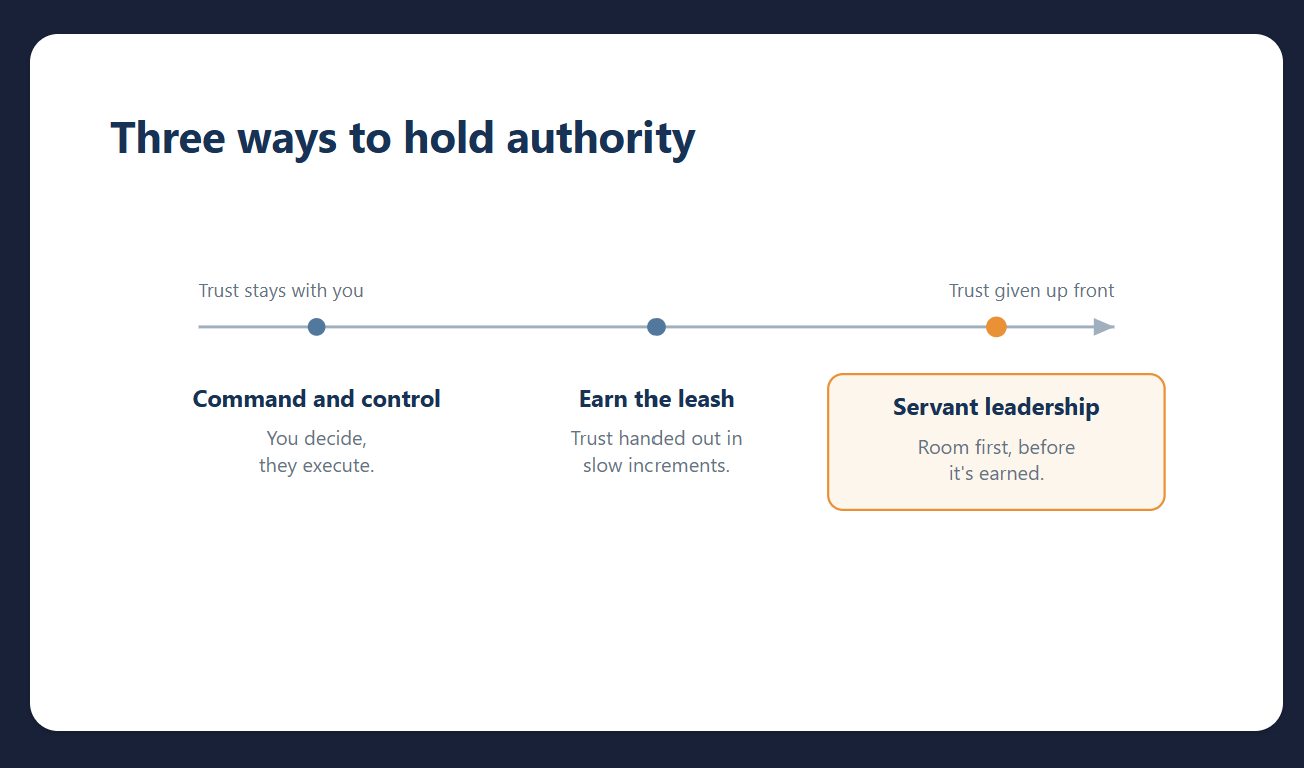
There are roughly three ways to lead and manage:
Command and control: you decide, they execute.
Earn-the-leash: trust is a reward, you hand it out in slow increments once people prove themselves.
Servant leadership: you give people room first, before they've earned it, and you find out who they are by what they do with it. You’re empowering them.
How do you balance strong opinions about how things should be done vs. simply enabling people?
We keep talking about “empowering” people without really defining what it means or how to actually do it, even though people can simply struggle with being empowered.
Empowering people means to me that I give them room to act, room to make decisions, and make mistakes right away.
The upside shows up fast if you’re doing this right away in a new job. You get room to be the new joiner, to read the ship before you steer it, instead of drowning in the tactical on day one by micromanaging everyone. You’re not the bottleneck; everything routes through for permission, which is half the reason you can actually think. Decisions get made where the information lives, by the person in the work who knows more about it than you do. You learn who your people are quicker than any review cycle would tell you, because what someone does with trust says more than what they do under supervision.
And every so often, you hand someone freedom they’ve never had and watch them light up, simply because they finally got the room to.
Those are the good sides. Give people that much room and it will go wrong, in a handful of ways I've now watched play out in every mandate I've taken:
Mixing up “asking for feedback” with “asking for permission”.
A lot of people never learned how to manage up and don’t know what it means to ask for feedback (which is important if you’re empowered) instead of permission, and go completely silent on you. They think managing a specific area means that they’re expected to have it all under control and not ever bother their manager again.People are not flagging insecurities.
Impostor syndrome sucks. It’s so debilitating because it also keeps you from flagging to others that you are struggling due to a lack of knowledge or other factors. If you’re convinced that you don’t deserve to be where you are, you will struggle to grow from it and won’t ever get out of that cycle.False sense of loyalty.
A culture where empowerment did not exist before most likely repressed, skipping the management lines and challenging people in front of each other, or voicing concerns early and instead waiting for someone else to speak up on issues, and creating a false sense of loyalty towards others.I’ve seen it happen a couple of times that team members started to cover for their team leaders or others because they didn’t want to get them into trouble, or because they felt that they were “snitching” on them. The result of that is usually exactly what they wanted to avoid: when problems do surface, they have festered to a point where drastic measures are the only way out, and then everybody is suddenly in trouble.
Thinking that empowerment is about them and not the team.
When you get responsibilities that you didn’t have before, the expectation is that you manage those responsibilities, not necessarily that you have to do it all yourself, or even worse, make yourself shine in the best light possible. Managing something is about creating clarity first, and being clear about what’s working vs. what’s not. Before you have that clarity, you can’t solve the problem.Doing good things but not talking about them.
I’ve had my fair share of high performers with me, and some of them never learned how to talk about the good things they do. This does not mean that you have to or even should boast about your achievements on every corner and all-hands presentation or shout about how cool you are.
It goes back to point 1. In this list, if you ask for feedback from people about what’s going on and getting their advice on your work, you automatically are sharing context with people, and they see what you did.
And besides, our decision quality is generally better in a team.
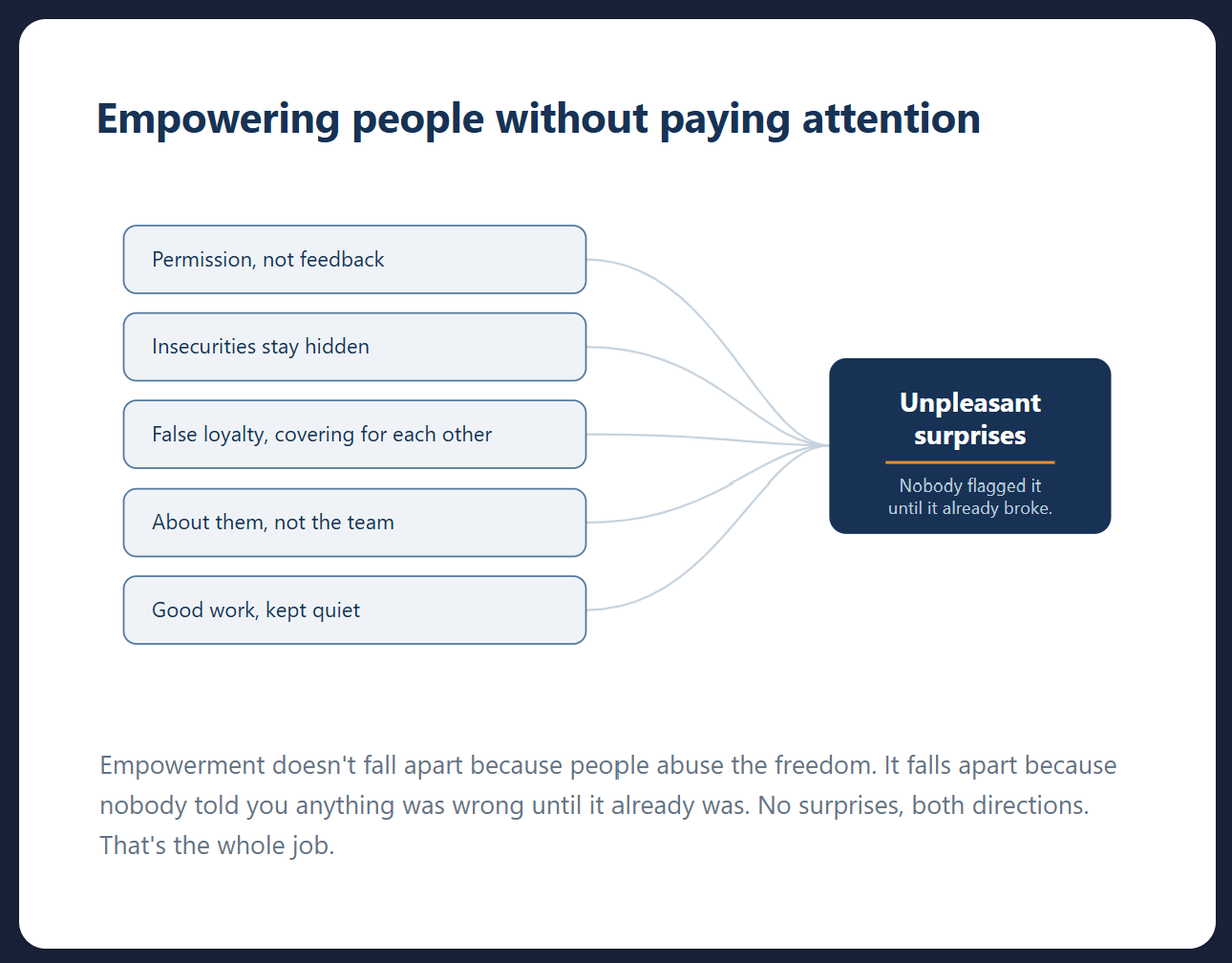
Empowerment doesn't fall apart because people abuse their freedom. It falls apart because nobody told you anything was wrong until it already was. That's the cost you're paying for the trust you gave early. No surprises. That's the whole job, both directions.
Managing up
The theme is a lack of actionable transparency upwards for most people. Actionable transparency to me is things a manager needs to know as a minimum to run their function. No surprises.
That’s literally it.
Let’s say you’re getting a specific issue to handle from your manager, instead of vanishing for 4 days and working on something in complete silence (or stuff it into a backlog to never be heard about again), do this, always:
Repeat & confirm: Repeat back what you think the assignment is in your own words immediately, and why you believe it matters for the manager/business. Interpreting unclear instructions without asking back is getting you in trouble almost certainly.
“How would I handle this?”: Structure for yourself how you think the first 10 minutes on working/handling that issue would look like. The more uncomfortable you feel about it, the more important it is to do the next step diligently:
Create an “Okable” summary: Write up a short paragraph on how you would approach handling it as specifically as possible and send it back to your manager for feedback. You don’t always have to ask for permission here; framing it as an FYI gives them an opportunity to help or simply reply with “sounds good”
“I’m talking to some stakeholders” is not specific enough. Try: “I’ll talk to Gary S. and ask him what they did in the past quarter on project x”
I sometimes sketch an example Miro board or document structure to help visualize how I think about things and share it structurally way before it’s complete.
Work the problem a bit until you understand it. It just takes time to see the real scope of an issue. At this point, you probably know more than your manager about it because you did some diligence. Don’t work on it for days, work on it for an hour.
The big picture: Now frame how the thing fits into the big picture; never assume someone knows your backlog or skills.
For instance: “I don’t think it’s a huge issue, and I think I can fit it into what I’m currently doing. Leave it with me”
or: “This seems like a big lift, and I’m not yet clear how much it means for the team or me. We might have to deprioritize some other things further down the line. I’ll get back to you.”
or: “I’ve never done X and don’t know exactly how to approach handling it, can you help me get started or tell me with whom I should try to get a handle on it?”
Keep the process iterative and update on a cadence that increases over time. It takes time to find the perfect way to work on things, but this way has never failed me. The amount of time you invest in the beginning is going to pay back later 10-fold.
Generally
Never say “I understand” if you don’t. Asking questions is a quality, not a burden. Disagreeing and committing is sometimes necessary, but not the same as not understanding something. Your impostor syndrome might tell you that you should know something and therefore don’t deserve to ask.
It’s ok to not be perfect, and your manager’s job is to enable you so you can learn and grow. Growing is only possible if you make your gaps visible and accept them.Have a recurring meeting with your Manager that looks at your overall status, not just your local, individual problems. You might seem to understand every single thing you’ve been given, but you might still be completely overwhelmed by your job. It’s important to step back occasionally and not get lost in the tasks you’ve been given, but to also just simply be able to say: “I’m overwhelmed and underestimated my commitments and need to get rid of some things that we originally agreed on”
You’re not helping the team by overworking yourself without speaking up. You cover up a resource shortage in the best case and burn yourself out in the worst case, and that doesn’t help anyone.
Managing down as a servant leader
Giving people the responsibilities that they can’t handle entirely is extremely time-consuming, but it comes with the territory.
Aside from operationalizing and encouraging people to do what I wrote above for managing up:
Never punish failure: If you give freedom to people, things will go wrong. How you handle those moments define how trust is handled forward. It’s a great opportunity to clearly call out things immediately. but not in a “you messed up” way, but more like “this wen’t wrong, and it’s good that I can tell you directly”
Don’t be ruinously empathetic; instead, hold people accountable. I find it extremely important to be firm on calling things as they are without watering them down. Especially as a servant leader, it’s easy to water down feedback to keep the peace or because you feel bad for someone. When people do that with me, it feels like they’re taking away the power and meaning of any genuine compliments or criticism they have for me in the future. (The term ruinous empathy is from Kim Scott’s book “Radical Candor.”)
If you don’t act on difficult topics / people fast, your team will pay the cost over time. Being a servant leader doesn’t mean you enable everyone at every cost; it means you enable the team.
I learned this concept from Ravi Mehta in a course, many years ago, on Reforge: Double down on your strong performers and their strengths. That’s where the servant leader starts to make their team shine and should invest most time, not by molding weak links in the team into something they are not.
Don’t kill the messenger: If someone gives an important insight that triggers an action somewhere else in the business, it’s easy to forget to tell someone back that their work/information mattered a big deal because of it.
Trust your intuition: The best people managers I’ve had were the ones who trusted their intuition of an impression over what someone says ad verbatim. Especially when we talk about people overworking themselves into a burnout or generally struggling but unable to speak up. You can afford to be wrong here and there by trusting your gut, but you can’t afford to lose someone over something you already felt a couple of weeks ago but were not sure enough yet about.
Be ok with not being liked by everyone: It’s an uncomfortable truth in management, in order to protect your team, you have to accept that some people will resent you.
Be present: When someone invests time in communicating with you carefully, one of the most ruinous things you can do is to respond with something that proves that you didn’t pay attention:
Responding with AI-slop documents to personal matters.
Responding in a way that clearly indicates you didn’t pay attention
Resorting to general fake statements or ghosting instead of saying, “I currently don’t have time to look at it, I’m sorry”
Identify your introverts and write to them: It’s easy to listen to extroverts in a company because, well, they are extroverted and loud. Identifying introverts and slowly building a relationship with them is extremely valuable in my experience. They are just as important to listen to, and if I may use a stereotype, they usually do so in writing. They often struggle with the concept of aligning on things early, but profit the most from it in my experience.
Strong performers?
I watch out for four things:
They do the work.
They know their area.
They lift others up.
They create clarity, not confusion.
That last one is the whole piece. The people worth trusting early are the ones who reduce surprises rather than create them.
I wrote a deep dive on managing up that you can read here, which goes into much more detail:
The skill that gets you fired or promoted: managing up

I'm writing this article on the back of a frustration that happened last week and many times over the past year: